
Dentures St. Louis
Dentures are a great way to improve your smile and overall health.



A denture is a removable replacement for missing teeth and adjacent tissues. It is made of acrylic resin, sometimes in combination with various metals.
If you are considering dentures, The Dental Anesthesia Center will be happy to walk you through every step of the way. Call us today at (314) 862-7844 to make your appointment.
Types of Dentures
Complete dentures replace all the teeth, while a partial denture fills in the spaces created by missing teeth and prevents other teeth from changing position.
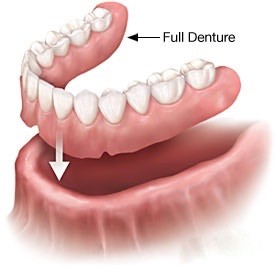
Candidates for complete dentures have lost most or all of their teeth. A partial denture is suitable for those who have some natural teeth remaining. A denture improves chewing ability and speech and provides support for facial muscles. It will greatly enhance the facial appearance and smile.
Complete or full dentures are made when all of your natural teeth are missing. You can have a full denture on your upper or lower jaw or both.
Complete dentures are called “conventional” or “immediate” according to when they are made and when they are inserted into the mouth. Immediate dentures are inserted immediately after the removal of the remaining teeth. To make this possible, the dentist takes measurements and makes models of the patient’s jaws during a preliminary visit.
An advantage of immediate dentures is that the wearer does not have to be without teeth during the healing period. However, bones and gums can shrink over time, especially during the period of healing in the first six months after the removal of teeth. When gums shrink, immediate dentures may require rebasing or relining to fit properly. A conventional denture can then be made once the tissues have healed. Healing may take at least 6-8 weeks.
Implant Overdenture
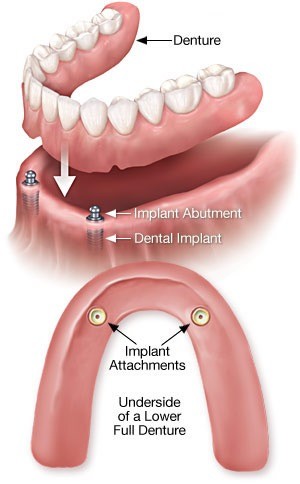
An overdenture is a removable denture that fits over a small number of remaining natural teeth or implants. The natural teeth must be prepared to provide stability and support for the denture.
Partial Dentures
Partial dentures are often a solution when several teeth are missing.
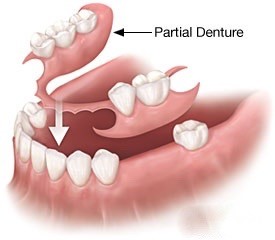
Removable partial dentures usually consist of replacement teeth attached to pink or gum-colored plastic bases, which are connected by a metal framework. Removable partial dentures attach to your natural teeth with metal clasps or devices called precision attachments. Precision attachments are generally more esthetic than metal clasps and are nearly invisible. Crowns on your natural teeth may improve the fit of a removable partial denture, and they are usually required with attachments. Partials with precision attachments generally cost more than those with metal clasps.
How are Dentures Made?
The denture process takes about one month and five appointments: the initial diagnosis is made; an impression and a wax bite are made to determine vertical dimensions and proper jaw position; a “try-in” is placed to assure proper color, shape, and fit; and the patient`s final denture is placed, following any minor adjustments.
First, an impression of your jaw is made using special materials. In addition, measurements are made to show how your jaws relate to one another and how much space is between them (bite relationship). The color or shade of your natural teeth will also be determined. The impression, bite, and shade are given to the dental laboratory so a denture can be custom-made for your mouth.
The dental laboratory makes a mold or model of your jaw, places the teeth in a wax base, and carves the wax to the exact form wanted in the finished denture. Usually, a “wax try-in” of the denture will be done at the dentist`s office so any adjustments can be done before the denture is completed.
The denture is completed at the dental laboratory using the “lost wax” technique. A mold of the wax-up denture is made, the wax is removed, and the remaining space is filled with pink plastic in dough form. The mold is then heated to harden the plastic. The denture is then polished and ready for wear.
Getting Used to Your Denture
For the first few weeks, a new denture may feel awkward or bulky. However, your mouth will eventually become accustomed to wearing it. Inserting and removing the denture will require some practice. Your denture should easily fit into place. Never force the partial denture into position by biting down. This could bend or break the clasps.
At first, you may be asked to wear your denture all the time. Although this may be temporarily uncomfortable, it is the quickest way to identify those denture parts that may need adjustment. If the denture puts too much pressure on a particular area, that spot will become sore. Your denture can be adjusted to fit more comfortably. After making adjustments, you may need to take the denture out of your mouth before going to bed and replace it in the morning.
Start out by eating soft foods that are cut into small pieces. Chew on both sides of the mouth to keep even pressure on the denture. Avoid sticky or hard foods, including gum.
Care of Your Denture
It’s best to stand over a folded towel or a sink of water when handling your denture, just in case you accidentally drop it. Brush the denture (preferably with a denture brush) daily to remove food deposits and plaque and keep it from becoming permanently stained. Avoid using a brush with hard bristles, which can damage the denture. Look for denture cleansers with the American Dental Association (ADA) Seal of Acceptance. Pay special attention to cleaning teeth that fit under the denture`s metal clasps. Plaque that becomes trapped under the clasps will increase the risk of tooth decay.
Hand soap or mild dishwashing liquid to clean dentures is also acceptable. Other types of household cleaners and many kinds of toothpaste are too abrasive and should not be used for cleaning dentures. A denture could lose its proper shape if it is not kept moist. At night, the denture should be placed in a soaking solution or water. However, if the appliance has metal attachments, they could be tarnished if placed in a soaking solution.
Even with full dentures, you still need to take good care of your mouth. Every morning, brush your gums, tongue, and palate with a soft-bristled brush before you put in your dentures. This removes plaque and stimulates circulation in the mouth. Selecting a balanced diet for proper nutrition is also important for maintaining a healthy mouth.
Dental Anxiety
Many people avoid dental care only to find themselves in a dental crisis, and suffering. Does the need for extensive dental care combined with time-consuming visits and overwhelming fear sound familiar?
Modern, safe anesthesia techniques allow the fearful patient to have dental procedures accomplished without the anxiety associated with dentistry. Oral sedation, IV sedation, and general anesthesia services are available for all types of dental care, including dentures, fillings, crowns and bridges, root canals, implants, and more.
Denture Dentist St. Louis
At The Dental Anesthesia Center, we value our patient relationships, making it our priority to deliver the gentle dental care that you deserve from sedation dentists in St. Louis. We work hard to make you feel at ease by providing exceptional patient care in a relaxed, convenient atmosphere.
If you or a loved one is considering dentures, call us today at (314) 862-7844 to make your appointment. We are looking forward to meeting you!